
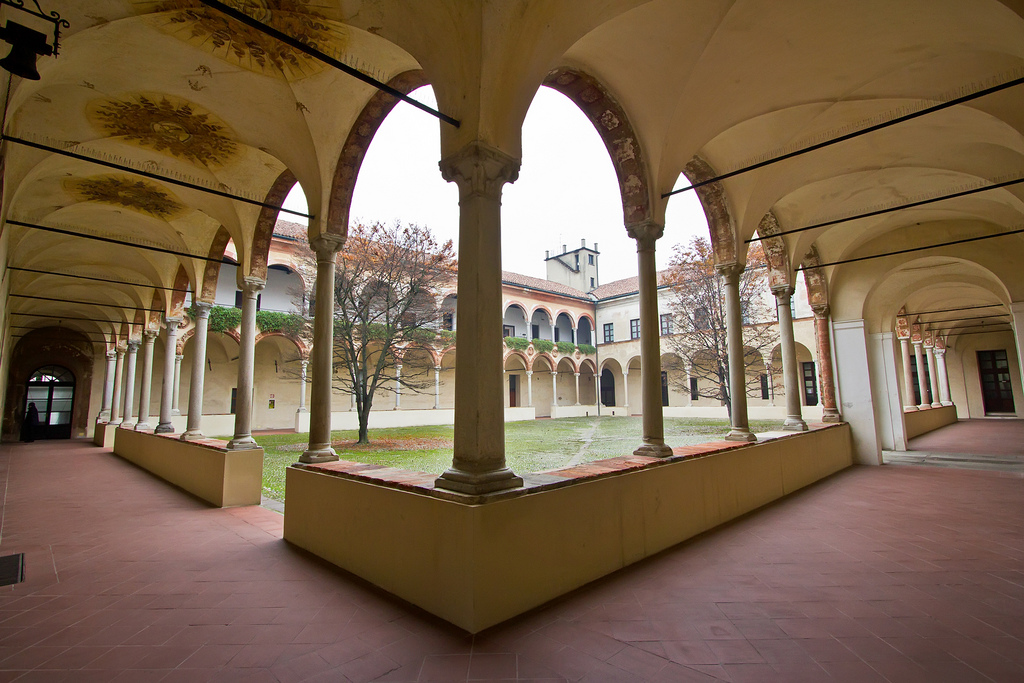
Il visitatore che varca la soglia dell’ex monastero rimane principalmente colpito dalle forme rinascimentali del chiostro edificato nell’ultimo quarto del XV secolo. Nel 1473 la comunità femminile del monasterium Theodotis passò sotto la giurisdizione dell’abate di San Salvatore: tale monastero di fondazione longobarda era stato da pochi decenni unito alla congregazione di Santa Giustina di Padova. Come i benedettini in seguito alla riforma avevano riedificato chiesa e strutture abitative, così le monache proseguirono nella seconda metà del XV secolo le radicali operazioni di rinnovamento architettonico e decorativo. In particolare, venne realizzato il grande chiostro porticato sui quattro lati, con brevi colonne poggianti su un piccolo muro. Nel 1478 potrebbe essere stata conclusa la porzione orientale del chiostro: il numero segnato nel capitello della penultima colonna di questo fianco indica infatti tale anno.
Il loggiato è presente su due ordini nel lato meridionale, mentre gli altri tre prospetti del chiostro mostrano, al di sopra delle arcate del piano terreno, una chiusura muraria che presenta una interessante decorazione a fresco ora non chiaramente leggibile. Le finestre sono incorniciate da una decorazione policroma in parte perduta; nelle porzioni murarie tra le aperture si riconoscono figure di sante e della badessa Teodote.
Il fianco settentrionale del chiostro si addossava al lato meridionale della chiesa di San Michele, di origine longobarda, che fu demolita nel 1867. L’edificio ecclesiastico era affiancato da una torre di cui ancora oggi è possibile percepire la consistenza.

The late 15th-century cloister
Visitors entering the former monastery are primarily struck by the Renaissance style of the cloister built in the last quarter of the 15th century. In 1473, the female community of the monasterium Theodotis came under the jurisdiction of the abbot of San Salvatore. This Lombard-founded monastery had been merged with the Congregation of Santa Giustina of Padua only a few decades earlier. Like the Benedictines rebuilt their church and living quarters after the reformation, the nuns also continued, in the second half of the 15th century, radical architectural and decorative renewal work. In particular, the large porticoed cloister was constructed with short columns resting on a low wall on all four sides. The eastern portion of the cloister may have been completed by 1478, as the date marked on the capital of the second-to-last column on this side suggests.
On the southern side there is a two-storied loggia, while the other three sides of the cloister feature, a wall closure with interesting fresco decoration, above the ground-floor arcades, which is now not clearly legible. The windows are framed by polychrome decoration, partially is lost; between the openings in the walls, figures of saints and the abbess Theodote can still be recognized.
The northern side of the cloister adjoined the southern side of the church of San Michele, which was of Lombard origin and demolished in 1867. The church was accompanied by a tower, the remains of which are still perceptible today.

Ascolta l’audioguida


 seminariopavia.com