“For where two or three are gathered in my name, there am I in the midst of them” (Mt 18:20)
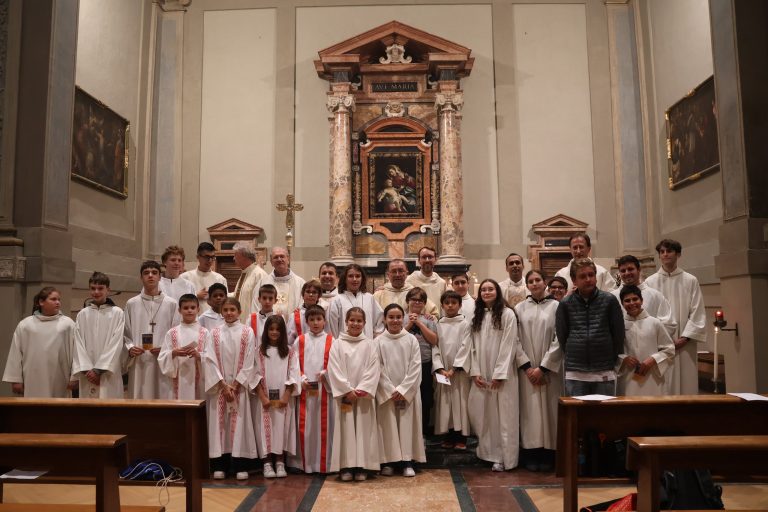
Never in my life has an evangelical promise been realised more clearly than during the Easter Triduum that just passed. At the invitation of Don Giovanni Iacono, Rector of our seminary in Pavia, and the missionaries of "Servants of the Gospel," Ursula and Chantal, twenty-three friends and I celebrated the Holy Triduum at the "La vite ei tralci" life centre in Albareto.
The presence of such a large group celebrating the Passion of Jesus challenges the common belief that churches are emptying of young people and testifies to how the pews are filling up, starting with university students who, in an age of so few certainties, necessarily seek them from Christ.
It's natural to wonder how these young people came to experience the most intense days of the liturgical calendar together. The answer isn't the same for each participant, as not all of them knew each other beforehand, but during these days the chemistry was such that we almost forgot about it.
Some met through the Missionaries of the Gospel group, others belong to the Franciscan Youth, and still others had met the vibrant seminary community through various editions of the "Ten Words" catechesis programme. Since this was the second edition of the experience, those who had already participated returned looking for similarly intense experiences, while those who were coming for the first time relied on enthusiastic friends and dear, expert guides.
PREPARATION: “Where do you want us to go and prepare for you to eat the Passover?” (Mk 14:12)
Some of us, on the evenings of the Authentic Week, gathered more assiduously than usual for weekday Mass in the Seminary, where Don Giovanni began to cultivate in us an atmosphere of listening and prayer with some evangelical meditations, which introduced us to the Mystery of the Passion.
On Monday, the jar of spikenard wasted by Mary intoxicated our senses, spreading its fragrance throughout our souls. This gesture was for us a prefiguration of the Blood of Christ shed on the wood of the cross and a symbol of an excessive Love that chose each of us individually for itself without reservations, calculations, or considerations.
Similarly, on Tuesday, when night fell for the apostles, we were with them, reflecting on the dark places of the human soul—places into which Christ, though anguished and aware of his Destiny, chose to venture. We thus asked ourselves which nights of our lives were stained by betrayals and wounds into which, until that moment, we had not allowed the Lord to penetrate. We therefore felt challenged to name those moments that now, as an offering, we would take with us on retreat, so that He might transform them.
On Wednesday, we remained to contemplate Judas' betrayal, acknowledging the times when we too, through our actions, have betrayed the Lord for gain. And, more than the well-known betrayal, we paused in amazement, recognizing that, even in the horror of being betrayed, Christ sought to reach out to Judas, still "Brother Judas." He called him friend again as he was being handed over to him, and consented to receive a final kiss from him before His Cross.
After these days, therefore, in which we felt called "Friends and no longer servants," where Christ wanted to call us spouses, we began to prepare the Easter for Jesus in our hearts, standing at attention, with our loins girded, ready to depart when He called us to leave the homes of our Egypt.
THURSDAY: “I have earnestly desired to eat this Passover with you before I suffer; for I tell you, I will not eat it again until it is fulfilled in the kingdom of God.” (Luke 22:15-16)
Arriving in Albareto, on the doors of our rooms we found our names accompanied by a randomly chosen biblical passage, an image that subtly alluded to the names engraved on the doorposts of Jewish homes in Egypt, covered in the saving Blood of the Lamb.
And, in this little surprise prepared by those who love us on earth, some of us were able to feel the Lord's caress even more clearly, finding verses particularly meaningful to our own stories. This was the case for two young spouses who spent the triduum with us, who were able to reread the Gospel proclaimed at their wedding.
In these days, the demonstration of their spousal love and their faithfulness to his vocation as Don Giovanni have accompanied us as a tangible testimony of the Grace that works in the life of those who allow themselves to be guided by God and bear abundant fruit..
After sharing what each of us would bring to the altar and those burdens that we would have liked to entrust at the foot of the Cross, we began to immerse ourselves in the liturgy of the Coena Domini, first understanding its meaning in tradition, then living it with renewed intensity.
We washed one another's feet, listening to the Lord's invitation, bending down to wet the feet of our friends with water and essence of Spikenard, experiencing an exceeding Love that offered itself totally for us.
We celebrated the last Mass before Easter, kneeling and contemplating in our hands Christ who daily becomes Bread, asking to be brought through us to the world.
Finally we placed His Body in the temporary home of the altar of repose, where He would await us for His Passion, giving Himself to us until nothing remained of Him.
The assembly did not dissolve with a blessing; in fact, it did not dissolve at all. The liturgy of these days has taught us to live like the disciples with bated breath, never breathing out until the new fire of the Easter Vigil. We did not sign ourselves with the cross nor were we dismissed so that we could go in peace. Quite the opposite: we remained restless at the foot of the altar, where the Sacrifice had been accomplished for us, keeping vigil in prayer, as in Gethsemane, and listening to what the Father would reveal to us. And there, where the sign of His Love had been consummated, we each placed a small piece of paper on which we had written the question we wished to find an answer in these days.
FRIDAY: “Greater love has no one than this, that a man lay down his life for his friends” (Jn 15:13)
Faced with the call to let ourselves be loved and to love our brothers in His way, we immersed ourselves in a long time of individual prayer, trying to create silence in our hearts so that He could truly speak above the noise of our thoughts.
And from the abundance of His words we drew to share with our friends in small groups. It emerged how the Lord's work intervenes in our lives slowly, like a drop eroding a stone, how the gratuitousness of His self-giving destabilizes us, and how in our inner desert we are challenged to give Him carte blanche.
We began in the afternoon by walking with Jesus on the path of His Cross, meditating on all the crosses He continues to bear with His Body, the Church, enduring the suffering of a world pervaded by wars, injustices, and human cruelty.
At the end of our Calvary we had to acknowledge the death of Jesus, living the liturgy of the Lord's Passion. We focused on the term memorial, thus defining the celebrations of the Holy Triduum, aware of how His Sacrifice is perfect and complete. In this way, it is as if we were with Him in Jerusalem in 33 AD.
We discovered the difference between “memory” and “memorial”, experiencing how His Sacrifice is perfect and complete, and does not need to be remembered but rather simply lived. Together, we were truly with Him in Jerusalem, at the foot of His cross.
The chapel was emptied of His Body in the Bread, and so the tabernacle, open and empty, reminded us of His pierced side. We extinguished all the candles, a sign that the living Presence of the Lord no longer resided among us.
We adored the Cross, not as an instrument of torture for our Saviour, but as the wood that bore the body pierced by the “Happy Sin that merited such a great Redeemer.”.
Before it we bowed and fixed our gaze on our pastor Don Giovanni, as he prostrated himself on the ground as on the day of his ordination, as a symbol of the Church as bride, who feels humbled by the death of her Spouse and, in the place of His death, decides to give herself to Him, despite her limitations.
At the conclusion of this meaningful liturgical act, we reflected on the sacrament of Reconciliation, reminding ourselves of its value in the path of salvation that Christ has prepared for his Church. And by examining our consciences, we prepared our hearts for the possibility of going to confession the following day, noting and placing at the foot of the Crucifix any lack of love for which we asked forgiveness.
SATURDAY: «Behold, I make all things new" (Rev 21:5)
Entering the church on Saturday morning, with the tabernacle wide open and empty, without even the crucifix, was shocking. Only Mary remained, who had remained with the women after witnessing the death of her Son and Saviour, entrusted to John and the nascent Church. With her, we paused in the mystery of a land blooming in spring with rare beauty, even though it had swallowed its Creator within its womb. With her, we heard the words of one who spoke at a moment when we no longer knew how to do so.
«"A great silence because the King sleeps: the earth is stunned and silent because God made flesh has fallen asleep and awakened those who had slept for centuries. God died in the flesh and has descended to shake the kingdom of the underworld [...], he goes to seek the first father (Adam), like the lost sheep. […] And taking him by the hand, he shook him, saying: “Awake, you who sleep, and arise from the dead, and Christ will shine upon you. I am your God, who for your sake have become your son, and in my power I command […] those who were dead: Rise! […] For I did not create you to remain a prisoner in hell. Rise from the dead. I am the life of the dead. You were forbidden to touch the symbolic tree of life, but I, who am the life, communicate to you what I am. The heavenly throne is ready, the bearers are ready and at your command, the hall is prepared, the table is spread, the eternal dwelling is furnished, the coffers are opened. In other words, the kingdom of heaven has been prepared for you from the eternal ages.» (from an ancient homily on Holy Saturday).
«Eastern icons show Jesus descending into Sheol, breaking down its gates, reaching Adam, lifting him up, taking him by the wrist (where life is measured) and dragging him with him.é. And behind Adam sets out the immense caravan, the immense pilgrimage of humanity.à towards life» (E. Ronchi).
Christ, descending into the netherworld of the earth and of our hearts, seized us by the wrists so we would not slip from his grasp and forcefully drew us to himself so we could return to live with him in the Kingdom, where we will reign with him forever. His "Catabasis" shakes the world, which restores itself to a new equilibrium.
The shock of the empty chapel turned to a buzz at the announcement of the end of darkness. In the light of the garden—Eden, Gethsemane, and then the heavenly Jerusalem—we were able to enjoy Reconciliation, and, inspired by a newfound joy, we found ourselves confessing our struggles and hopes to our friends, too, finding ourselves so similar and understood that we shed tears of relief.
When the chapel had become an almost hostile place in the echo of its abyss, we found the Spirit in the Temple that were our friends, in the place where His Body had wanted to give itself.
We worked hard to decorate a church that would be filled again: with wood to light the Easter flames, with flowers that on the altar would witness the renewal of Jesus' Promise to be with us every day in His Bread until the end of the world.
THE VIGIL: “He has risen, as he said; he has risen from the dead, and is going ahead of you to Galilee” (Mt 28:6-7)
The starry night began to shine even in the brazier, where we let our questions and our mistakes burn, so that Easter could be nourished by our humanity.
From that fire we drew to light the Easter candle and our candles, which we lit in a chain of flames.
These flames, individually feeble and barely resistant to the wind, yet in concert, were able to revive the dark chapel. Likewise, the unity of the faithful, alone few and fearful, is able to spread the Light of the Lord throughout the world.
We rejoiced and exulted at the announcement of the Risen Christ who made all things new, giving meaning to all the Old Testament prophecies we heard proclaimed in the liturgy of the word.
From the light of the candle, the new water was blessed, which will generate new children for the Church, which would sprinkle and wash us as on the day of our Baptism, and which, finally, will be used to sprinkle the children accompanied back to the doors of the Father's House.
Finally the Sacrifice was renewed, the Lamb returned to our Table and we fed on Him once again.
On Easter Sunday we returned to our Galilee, allowing the Lord to go before us, committing ourselves to bringing into our daily lives the good news and the joy discovered in that community.
And in our Galilee we have met, among ourselves and with the Lord, in the knowledge that we are not alone in walking in our daily lives on the paths of the Risen One.
The article will be published in the Diocesan Weekly Il Ticino of April 24, 2026.
Photo gallery