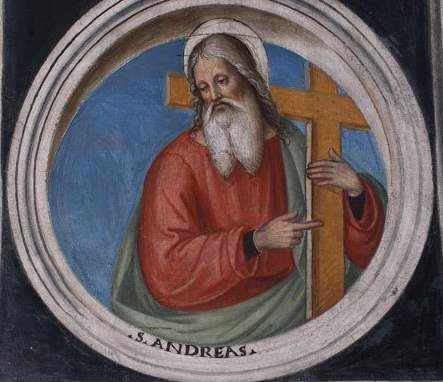
Saints Andrew and Syrus: tradition and devotion
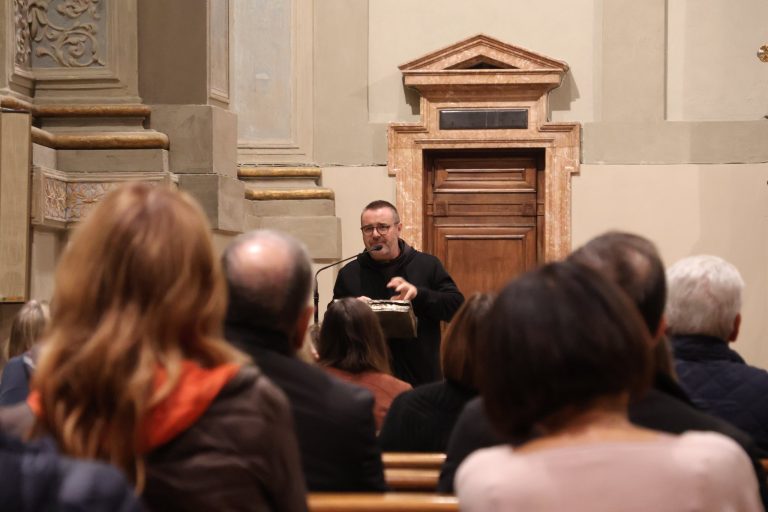
Conversation by Don Giacomo Ravizza
The feast of St. Andrew has always offered an opportunity to commemorate people, places, and events linked to the history of the local Church, while not forgetting that its experiences have sometimes had an impact on social and political life. Let us strive to preserve this legacy, which tradition has handed down to us, not passively, not merely with a conservative desire, but with the awareness of humbly rendering service to a history that deserves attention and is worthy of being entrusted to the future.
This year we are making this intention and this desire concrete by revisiting a somewhat dated text, it was published in 1993 precisely on November 30th, it is a small volume entitled: Saints Andrew and Syrus tradition and devotion. The discovery of this work is recounted in the introduction by Don Ermanno Segù, then director of the Seminary Library, a careful and rigorous director (Don Ermanno left us some time ago on April 29, 2000), but those who frequent the seminary library still feel his spirit. Don Ermanno writes: "While cataloging books printed in the 16th century, some time ago, I came across two short works extolling our city of Pavia, collected in a single volume by an 18th-century binder. But as I turned that volume over in my hands, I noticed a slight bulge between the two works, and so I discovered a small booklet with the evocative title "Dialogue between St. Siro and St. Andrew. It immediately struck me as a beautiful reference: St. Siro, patron saint of our Church in Pavia, St. Andrew, patron saint, always, of our Seminary. These are just a few pages collected with a devotional intent. The work dedicated to the bishop of Pavia, Fabrizio Landriani (1617–1637), was composed by the Franciscan friar Bernardino da Casteggio. The operetta, composed in 1628, is a charming testimony to the simple yet lively devotion that was nurtured at that time towards these two of our patrons (especially St. Siro, in my opinion). Thus was born the desire to make this rediscovered small composition known to everyone so that the humble voice of friar Bernardino da Casteggio may resound once again to sustain the veneration towards the two holy apostles." The poem's protagonists are therefore two saints, one linked to the entire diocese of Pavia (St. Siro) and another linked to a single place, the Seminary, which is and remains the heart of the diocese. Rereading this introduction, a question came to mind: could the text convey a sort of primacy of attention the author intends to develop? Does Brother Bernardino intend to foster greater devotion and veneration for St. Andrew or St. Siro? The answer seems clear to me, first and foremost, from the author's title for his composition: "Homage Written for Blessed Siro, First Bishop and Patron of Pavia." So perhaps the author is more concerned with writing about St. Siro to spread knowledge and worship of him than with St. Andrew. This hypothesis can also be confirmed by the fact that at the end of the composition we find a hymn and a prayer to St. Siro.
We ask ourselves: Who is Friar Bernardino da Casteggio? He describes himself as the Most Reverend Father Bernardino da Casteggio of the Order of Friars Minor of the Strict Observance of St. Francis, a reformed Franciscan group. At that time, Friar Bernardino da Casteggio lived here in Pavia in the monastery of Santa Croce, which was attached to the same church. The monastery and church were located in the area where the Francesco Pertusati retirement home now stands. It would be a long discussion to dwell on this matter; briefly, let's say that the mother church was the Ecclesia Sancti Theodori Martiris. The church changed its name when Cardinal Bernardino Lovati of Pavia, from the title of Santa Croce in Gerusalemme, assigned it to the Friars Minor Observant in 1476; they remained in Pavia until 1568, when they were replaced by the Reformed Friars of St. Francis, the community to which our Friar Bernardino belonged. Here the friars spent about two centuries of relative tranquility and industrious activity, as Pietro Scotti writes in the volume Santa Croce the Church and the Monastery now the Francesco Pertusati retirement home. During the Napoleonic era, the monastery was suppressed in 1810 and the entire complex (Church and Monastery) became the property of the Cassa di Ammortizzazione in Milan, but the Congregazione della Carità of Pavia began work in September 1811, managing to purchase everything in 1812 to place poor disabled beggars there. The retirement home was opened in 1812.
In addition to the "habitat" on Friar Bernardino we also have some other information, even if it is quite general information. Prelini recalls it in the first and second volumes of his work on St. Siro. Prelini writes (C. Prelini, Saint Siro, First Bishop and Patron Saint of the City and Diocese of Pavia. Historical-critical study., Pavia 1890; vol. II, p. 457-458): «If the taste of the times had been less adverse, Father Bernardino da Casteggio, a Minorite of the strict Observance of St. Francis, of whom we have already made mention in the first volume on page 78, would not have been a despicable versifier.[1]. His work is a "Dialogus In D. Syrum Primum Episcopum et Patronum Papiae …. cum Hymno, et oratione eiusdem B. Syri ad calcem addictis. — Ticini, apud Rubeum". The dedication to Bishop Fabrizio Landriani is dated December 1, 1628. This pastoral dialogue is set in a forest between Syrus and the Apostle St. Andrew, who, after recounting the multiplication of the loaves in detail, predicts the saint's apostolate in Pavia. It is a cento cobbled together with verses and thoughts by Virgil, not without the indispensable 17th-century touches. The Sapphic Hymn, which follows it, was more fortunate than the Dialogue, having had the honour of at least three other editions. Interesting is the addition that Prelini makes further on: "The plague of 1630 inspired not only verses, which unfortunately feel all the terror of the fatal disease: but it also encouraged the orators, and among these the aforementioned Father Bernardino da Casteggio, to have recourse to St. Siro. In fact, the "Spiritual Discourse to the Royal City of Pavia in the present travails of the plague and other great dangers, in which is discussed the protection and praise of its first Bishop and principal protector, St. Siro, composed by the MR Fra Bernardino da Schiateggio, Theologian of the Order of Reformed Observant Minsters and Lector in the Monastery of Santa Croce in the same city - Pavia, heir of the Rossi, 1630" was printed at that time.
The author, with a great deal of fuss, points to St. Syrus as a highly skilled physician for curing the plague and invites the people of Pavia to trust in him. He recalls the saint's patronage against Alboin; he recalls that he "diverted bloody wars, extreme hardships, floods, storms, lightning, earthquakes, sudden deaths, and other grave scourges, which were due (O Pavia) to your sins. How many times was he seen driving out enemies on the ramparts of your walls, as the iron balls hanging from his ancient image in the Cathedral testify? Hence he can appropriate to himself what is written in Isaiah: 'Your walls with my eyes always.'" Then turning to Pavia, he thus implores her: "Have recourse to that sacred tomb where rests the precious treasure of those venerable bones, which were once a living temple of the Holy Spirit... Be assured, Pavia, that the contagion spread by sedentary men is nothing but a cup of poison that the Lord has mixed for you; they have served for nothing other than cupbearers to offer you the cup of the Lord. God sent it to you, and they have brought it to you; they demanded your destruction, God demands your amendment. The calamities and terrors of the pestilence have passed; (C. Prelini, Saint Siro, First Bishop and Patron Saint of the City and Diocese of Pavia. Historical-critical study., Pavia 1890; vol. II, pp. 457-458)
A portrait confirmed by other sources but which time makes us ignore[2].
In conclusion, let us dedicate a few minutes to our writing: its structure is clear: a laudatory address to Bishop Fabrizio Landriani, followed by the prose presentation of the topic of the dialogue and then in hexameter verse the dialogue between Siro and Andrew, a dialogue which immediately gives way to the long monologue of the apostle Andrew, and finally a hymn and a prayer to St. Siro.
The fundamental tone of the poem is that of interiority, of intimacy, of feeling.
The poem's placement in a natural environment, perhaps today we might call it ecological, is precisely reflected in its correspondence with the character or the interior situation being described; in other words, nature itself becomes almost a living character in perfect harmony with the type of person it represents, and so the initial dialogue between the two protagonists, two saintly and celestial figures, cannot help but have the outline of a serene, luminous landscape. I read a short passage: "Syrus: Oh furrows so happily traversed by the plow! Oh, barley plant entrusted to the smiling clods! Oh, harvests! Oh, dear ears of corn of our homeland! One day you gave me, as precious gifts, five loaves (this eternal and unforgettable day must always be remembered). Oh, fish born from the fertile sea of Galilee and from it offered to Christ on the Galilean shore! Andrew: O Syrus, my crown, why are you in the woods? What dark worry has brought you, moaning, to the shady refuges of the woods and groves? What are these tears of yours? And what sighs, uncaught by the wind (but I heard them), break the words begun? As I was just arriving from the nearby hill, I heard great sighs breaking the swaying woods.
In this light, the beautiful description of the city of Pavia also stands out. "There exists an ancient city blessed with soil and pleasant climate, where rivers of milk flow and rivers pour nectar into their waves, springs yield honey, a land rich in fruit: it is the city of Pavia, located on the sunny plains of the Insubres. Here you can admire the spring suns, the meadows smiling with verdant grass, colourful grapes hanging from the vines, and branches laden with buds swelling on the trees, and the cut crops that satiate the hungry farmers. You can also admire fat cows and herds of bullocks that, protruding from the bushes, lap the riverbanks, and bulls that extend their long horns, and finally, in the wide countryside, the woolly flock. You will see, then, this famous city that raises its threatening towers to the sky, almost equaling it, and raises its mighty mass to the stars;… Here the divine will calls you. You, as bishop, will be sent to this city and will be consecrated shepherd of such a large flock.".
Conversely, when a negative character or reality is involved, even the natural "habitat" is marked by negativity; an example that is not easily forgotten is the description of envy: "There is a hideous place, a cavern of dire squalor, an immense, large, deformed cavern, covered with marshy slime: it is the dark house of envy. Here she sits, rolling sad eyes around, pale with a wrinkled face, her serpentine hair is unkempt, her tongue, coated with poison, is swollen, her few teeth are purple with rust, the poisonous herbs of aconite, crushed, are her miserable food, and beneath her teeth the torn serpents quiver. Laughter is absent except that which the pains of what is seen have produced, sleep is absent except that which mourning, tears, and groans instill, with hoarse whispers, in the bloodshot eyes. She cries when you laugh, she laughs when you weep over painful events. She is torment to herself. She spins her cruel stings, dipping them in her own blood.
Here the lord of Hell hastens and from afar speaks thus: ”O queen, my consort in sorrows,.».
The prophetic monologue of the apostle Andrew that occupies the central part of the poem describes the future election of Siro as bishop of Pavia, his arrival in the city, his evangelizing action, dwelling in particular on the miracles he performed. It is a precise account of what the first holy bishop of Pavia accomplished with specific references to his preaching, to the administration of the sacrament of baptism, to the signs with which Christianity materialized in a living experience of the church: "from a small hill you address the crowds around you and reveal to them these mystical realities: the venerable God, one and triune, the Son who came down from heaven - (the history of salvation) while you speak such truths, the whole square resounds with cries that wound the heavens... no time is wasted, those present ask to be immersed in sacred baptism... you sprinkle the bowed heads with the new bath and place in the heart the highest foundations of eternal faith that may always grow over the course of time... the sick vie with each other to try to touch the sacred vestments, the wasted bodies put fevers to flight and the diseases disperse in the wind...".
We can ask ourselves a final question: Is it all and only a work of exaltation, praise, and celebration of a saint? Certainly, yes, but Friar Bernardino's final Magnificat [as St. Andrew expresses it at the end of the poem: "It is truly so, dear son. The poor have become great for him who is in heaven... Thus you know that God has despised opulent palaces and valued the heights of a vile hovel; thus God, from the heights of heaven, disdains the proud and exalts the humble, and thus breaks swollen necks.] almost seems to want to lead the reader to become aware of a golden rule of Christian life that opens the path to holiness for all: God has chosen and chooses those who are small to accomplish the great works of faith. As I concluded the 1993 preface, so I conclude our familiar conversation. «A poetic dialogue, therefore, which, while requiring the reader to have some sensitivity to this literary genre, gradually wins him over and by the end of the reading he is involved, not to say "instructed," in a wisdom that has lost none of its relevance’.
[1] «Father Bernardino da Casteggio also published a dialogue in the form of an eclogue with the title: In D. Syrum primum Episcopum et Patronum Papiae Dialogus. It is a Virgilian cento, in which St. Syrus and St. Andrew the Apostle are put on stage to discuss the miracle of the five loaves and the two fish, and in which St. Andrew is shown predicting to St. Syrus the mission to Pavia and the other surrounding towns. It is a Latin poem not unworthy of a scholar imitating the Mantuan poet, but history would have nothing to gain from it. It is dedicated to Monsignor Fabrizio Landriani, bishop of Pavia. At the end is the Sapphic hymn cited here». C. Prelini, Saint Siro, First Bishop and Patron Saint of the City and Diocese of Pavia. Historical-critical study., Pavia 1880, vol.I, p.78.
[2] 1630. The learned priest Don Cesare Prelini (0 says that in 1630 not only the deadly plague disease inspired people to write verses, but also the great trust that people had in Saint Siro, as protector of the diocese of Pavia, encouraged them to turn to him. Thus Father Bernardino da Casteggio, a Friar Minor Observant of Saint Francis, who could have become a true poetic glory of Casteggio, because he could have been a good versifier if he had not had the bad taste of the times against him, had already written a pastoral dialogue in 1628 in which he has Saint Siro and the Apostle Saint Andrew speak, and in 1630 he composed a Spiritual discourse to the royal city of Pavia in the present tribulations of plague and other great dangers, etc. Printed in Pavia by the Rossi heirs in 1630. The author, with a great deal of rhyme and phrase, invites the people of Pavia to trust in San Siro. There is also a hymn in Sapphic meter by Father Bernardino da Casteggio, which begins: hanc tibi laudis modulamur hymnum. Father Bernardino da Casteggio was a theologian and lector at the Monastery of Santa Croce in Pavia. Quoted by A. Cavagna Sangiuliani, the Vogherese countryside, scattered memories of the history of the homeland, vol. II p. 525-526, Casorate Promo 1890.
Also noteworthy is what Father Andrea Merli states in his writing: Life of Blessed Bernardino of Feltre, Pavia 1918. P. «Therefore, following in the footsteps of these illustrious writers, I undertake to write the life of this Hero, whose fame resounded throughout Italy in the fifteenth century… The only [life] that deserves to be read without much reluctance is that of Father Bernardino da Chiasteggio, who produced it in octavo in 1651, later reproduced with the addition of the Cult of the Blessed One by Father Innocent of Pavia in 1664, of which I will make use in large part, without however ever deviating from the aforementioned Bollandists». It is recalled that around 1733 the body of the Blessed Bernardino da Feltre “due to war” was transported from the Monastery of St. James to the more secure church of St. Croce.